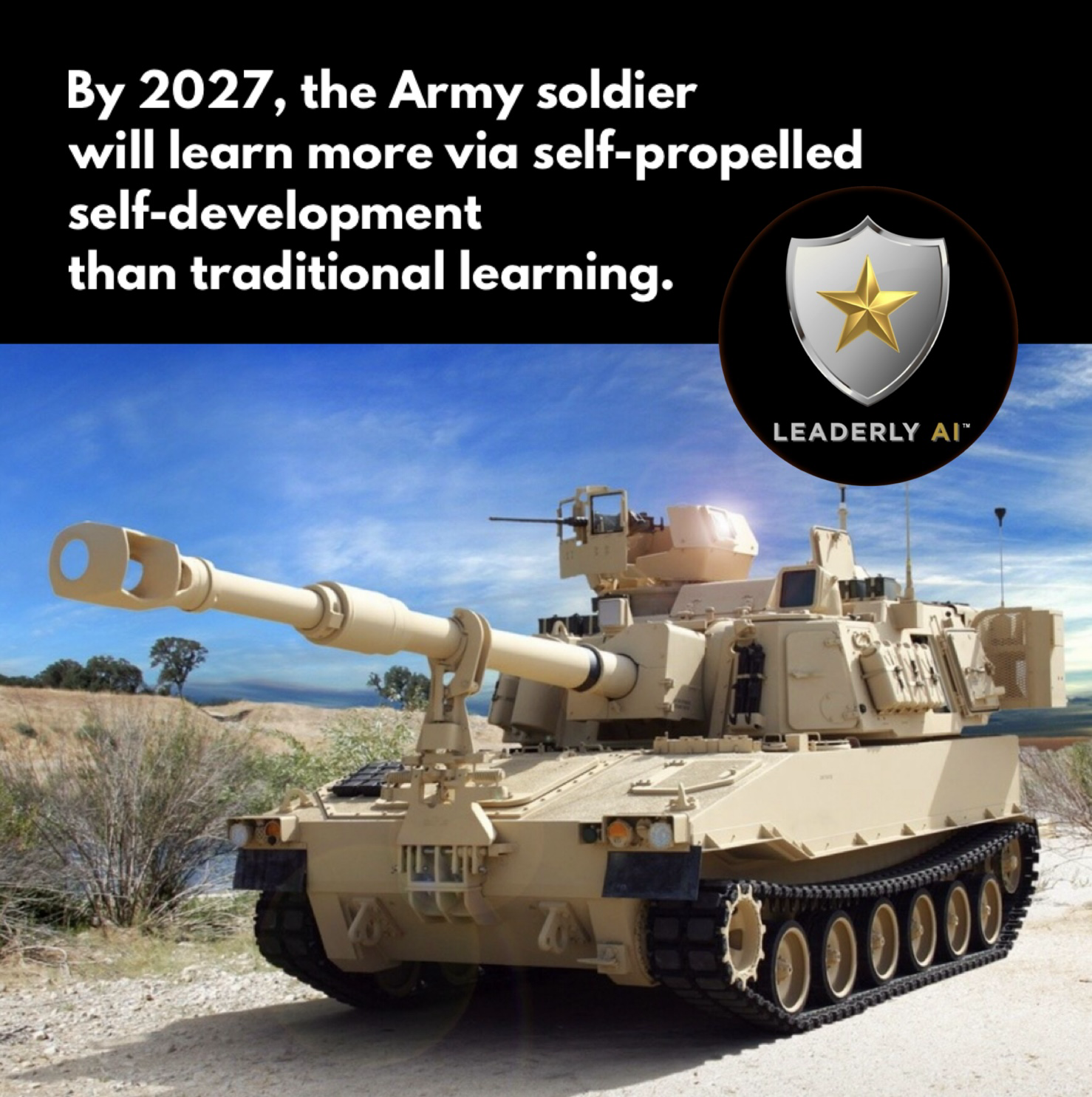
The landscape of AI training technologies for military self-development is poised for significant advancements by 2027. At Leaderly AI, we saw this coming in 2020 as we began to develop a mobile AI continuous learning and engagement system. But there are other lateral developments happening in the person to machine domain as well, and these developments excite our team just as much.
Several key areas in the US military are likely to see transformative changes, driven by rapid technological growth, increased investment in defense technologies, and evolving military requirements. Here are some advancements on the human capital and solider training front:
1. Enhanced Simulation and Virtual Reality VR Training
- Immersive Training Environments: By 2027, military training may leverage advanced VR and augmented reality AR technologies to create highly immersive training environments. Soldiers could train in realistic scenarios that replicate various terrains and combat situations, enhancing their preparedness without the risks associated with live exercises.
- Adaptive Learning: AI algorithms could personalize training simulations based on the individual soldier's performance and learning pace, ensuring that each service member receives tailored instruction that addresses their strengths and weaknesses.
Leaderly AI already has deployed first generation learning simulations that adapt to the learner and give instant feedback for iteration and improvement. Military branches can customize simulations down to the unit level to ensure readiness and familiarity with scenarios and problem solving.
2. AI-Powered Decision-Making Tools
- Real-Time Data Analysis: AI systems could process vast amounts of battlefield data in real time, providing commanders with actionable insights and recommendations. These tools can help in strategic planning, resource allocation, and tactical adjustments during operations.
- Scenario Planning: Advanced AI models could simulate countless battlefield scenarios, allowing military planners to explore potential outcomes based on different strategies and decisions, thus enhancing strategic foresight.
Leaderly AI is working with military veterans and first responders to develop adaptive planning tools to execute specific missions based on environment and constraints. The platform leverages experience from combat veterans in dynamic environments of change and adaptation.
3. Machine Learning for Skills Acquisition
- Continuous Learning Systems: AI could facilitate continuous skill development through platforms that analyze performance metrics and provide feedback. This could enable military personnel to engage in lifelong learning, adapting to new technologies and tactics as they evolve.
- Automated Skill Assessment: AI-driven analytics could assess soldier performance in training exercises, providing immediate feedback and identifying areas for improvement, which would help in crafting personalized training programs.
Leaderly AI provides over one million learnable moments already that are personalized to the soldier and customized by the organization. The learning is personalized to extend and expand soldier curiosity, with a range of rich media experiences that unlock audio, video and written moments for aiding retention and retrieval. Gamification and scoring also supports motivation and attention to perform at the standard set by the organization.
4. Collaborative AI Training Systems
- Multi-Agent Training Models: AI systems that simulate enemy tactics and behaviors could be employed to train soldiers in collaborative environments. This would prepare soldiers for real-world operations where they must work alongside AI systems and other autonomous units.
- Human-AI Teaming: Training programs could incorporate human-AI collaboration scenarios, preparing troops to effectively communicate and work with AI systems on the battlefield.
Leaderly AI has developed its own training feedback system with its own LLM AI agent called the Rainger,
an AI agent that is specially tuned to apply not just global knowledge but institutional knowledge that is more vital to military execution and readiness.
5. Data-Driven Insights for Training Optimization
- Predictive Analytics: By analyzing historical training data, AI can predict which training methods yield the best outcomes for different types of missions, allowing military organizations to optimize training curricula.
- Real-Time Performance Monitoring: Wearable technologies could collect data on soldiers’ physical and cognitive performance during training exercises, with AI analyzing this data to refine training approaches and improve effectiveness.
While Leaderly AI has not integrated wearable technology into its professional development system, it already is “carry-ready” technology that is optimized for delivering sustained learning on the smartphone technology that is in the hands of every soldier and sailor in the nation. Soldiers and leaders receive real time feedback on themselves, their learning, effort and level of engagement.
6. Ethical AI and Decision-Making Frameworks
- AI Ethics in Training: As AI systems become more integrated into military training, frameworks for ethical decision-making and accountability will be essential. Training programs may need to include modules on the ethical implications of AI in warfare, preparing personnel to navigate complex moral landscapes.
- Bias Mitigation in AI Systems: Advancements in AI will likely focus on reducing bias in training algorithms, ensuring that AI systems provide fair and equitable training scenarios that reflect diverse perspectives and experiences.
Leaderly AI provides self-propelled professional development that is also customized in real time to align to the values and principles of the organization. As such, Leaderly AI model reduces learning biases and focuses soldier attention not just on training, but also on the sustained commitment to engage with the values and principles of the organization every day. Values Bases Engagement is a hallmark of the Leaderly AI continuous program.
The military is mobilizing and optimizing continuous learning and sustained engagement. All of the above adds up to why we as combat veterans developed Leaderly AI. Traditional learning systems were made for a world that no longer exists.
Over just the next five years, the mobilization of AI in solder self-development will transform how soldiers are prepared for modern warfare. These advancements promise not only to enhance operational effectiveness but also to shape the future of military training paradigms, making them more adaptive, data-driven, and aligned with the complexities of contemporary and future battlefields.
- Drew Bartkiewicz, CEO of Leaderly and US Army Veteran