
Leader Talks
Listen to our latest Leader Talks
Short audio conversations on leadership, management, and coaching, from the Leaderly team.

All the Leader You Can Be
Suzanne Bates
This discussion takes a look at Suzanne Bates' book, All the Leader You Can Be, which posits that executive presence is not an innate trait but a collection of definable and cultivable qualities. Bates categorizes these qualities into character, substance, and style, arguing that their development directly impacts a leader's influence and effectiveness. The discussion further emphasizes the importance of self-awareness and provides a framework for leaders to understand how they are perceived by others. Bates contends that through targeted practice and coaching, individuals can strengthen their presence in areas such as communication and composure.
Leading Change
John Kotter
This discussion tackles John Kotter's "Leading Change," which provides a framework for navigating organizational transformations, emphasizing that effective execution, rather than flawed ideas, is key to success. This dialogue presents an 8-step process beginning with creating urgency and building a guiding coalition, progressing through forming a strategic vision, enlisting a volunteer army, and removing barriers to action. Generating short-term wins and sustaining acceleration are crucial mid-points, ultimately leading to the institutionalization of change within the organizational culture. Kotter highlights the importance of leadership, communication, and cultural integration for achieving lasting and impactful change, noting that successful transformation is a structured journey driven by people.
The Effective Executive
Peter Drucker
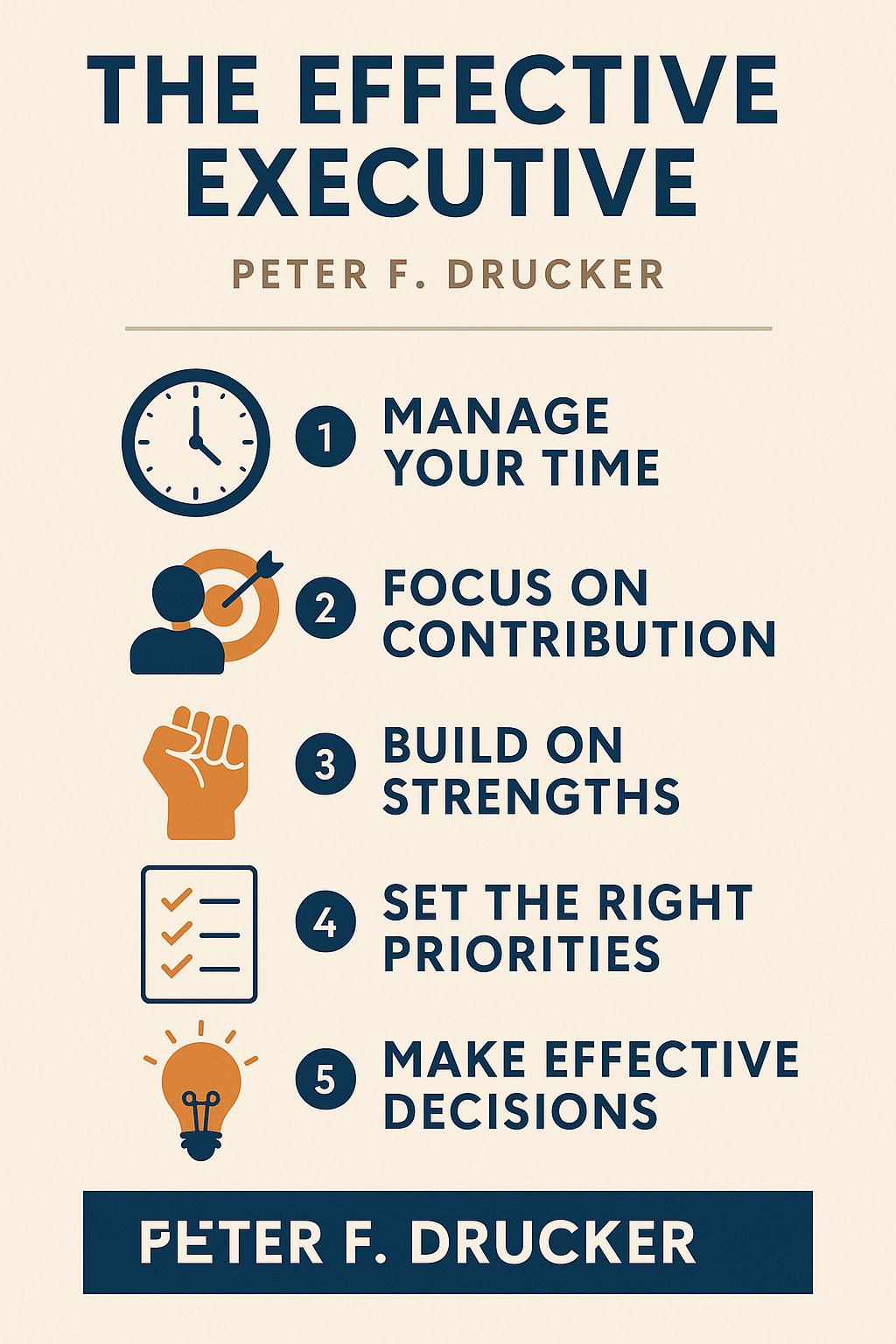
This discussion is about Peter Drucker's "The Effective Executive," which was published in 1967 and is a seminal work in management and leadership. Drucker asserts that effectiveness is a learned skill achievable through specific disciplines and habits. This discussion also outlines key principles such as managing time, focusing on contributions, leveraging strengths, and making sound decisions based on clear understanding. Emphasizing results over mere efficiency, Drucker provides timeless guidance for executives and professionals seeking to enhance their impact within organizations, even in today's dynamic environment.
The Paradox of Choice
Barry Schwartz
This discussion is about Barry Schwartz's "The Paradox of Choice," which contends that an excessive number of options in modern life often produces negative psychological effects. Instead of enhancing well-being, this abundance can trigger difficulty in making decisions, known as analysis paralysis. Individuals may also experience heightened expectations, leading to regret and decreased satisfaction even with positive results. The book distinguishes between "maximizers," who seek the absolute best, and "satisficers," who aim for a sufficiently good choice, suggesting the latter tend to be happier. Ultimately, Schwartz argues that the overwhelming array of choices can create a sense of tyranny, undermining the very freedom it intends to provide.

Think and Grow Rich
Napoleon Hill
This discussion explores Think and Grow Rich by Napoleon Hill, focusing on the power of desire, belief, and persistence in achieving success. The dialogue highlights how success begins with a clear, focused goal backed by unwavering faith and consistent effort. Hill emphasizes the importance of mindset, imagination, and emotional drive in turning thoughts into tangible results. While the message is timeless, it also invites reflection on how internal beliefs shape external outcomes. Cultivating discipline and a success-oriented mindset is key to turning ambition into achievement.

The Culture Map
Erin Meyer
This discussion explores The Culture Map by Erin Meyer, which examines how cultural differences influence communication, leadership, and decision-making in global work environments. The conversation offers a practical framework for understanding how people from different cultures give feedback, perceive authority, and approach conflict. Meyer identifies key dimensions—such as directness, hierarchy, and time orientation—that affect collaboration across borders. Her insights help professionals navigate misunderstandings and adapt their style to diverse teams. Embracing cultural awareness is essential for building trust and fostering more effective international collaboration.

Self-Reliance
Ralph Waldo Emerson
This discussion explores Self-Reliance by Ralph Waldo Emerson as a timeless guide to authentic leadership rooted in self-trust and individuality. Emerson champions nonconformity and encourages readers to follow their inner voice rather than external expectations. He argues that true power comes from embracing one’s unique perspective and acting with integrity. In a world that often rewards conformity, his message challenges leaders to stay grounded in their convictions. The conversation invites reflection on the courage it takes to express one’s true self, especially under societal pressure. Cultivating self-reliance is key to leading with purpose, clarity, and authenticity.

The Power of Introverts
Susan Cain
This discussion explores The Power of Introverts by Susan Cain, highlighting introversion as a strength grounded in reflection, depth, and a preference for solitude. Cain challenges the cultural bias that often favors extroversion in schools, workplaces, and leadership roles. She emphasizes how introverts contribute through thoughtful decision-making, focused creativity, and deep listening. The dialogue reframes quietness as a source of power rather than a weakness. Embracing introverted strengths leads to more balanced, inclusive, and innovative teams.

The Power of Habit
Charles Duhigg
In this conversation, the focus is on The Power of Habit by Charles Duhigg and how understanding the science of habits can lead to meaningful personal change. The dialogue explores the habit loop—cue, routine, reward—and why the brain relies on habits to conserve energy. There’s also a discussion on keystone habits, those powerful routines that spark transformation in other areas of life. Practical insights are shared on how to change a habit by shifting the routine while keeping the same trigger and reward. The conversation includes relatable examples and reflections on daily behaviors. It’s a thoughtful look into how small changes can create lasting impact.

Surrounded by Idiots
Thomas Erikson
This conversation explores the colorful world of human behavior through the lens of Surrounded by Idiots by Thomas Erikson. The dialogue breaks down the four personality types—Red, Yellow, Green, and Blue—and how they influence communication, leadership, and connection. It examines the roots of misunderstandings and how recognizing diverse communication styles can shift perspectives. Expect a dynamic discussion filled with real-life examples, personal insights, and practical tips for building stronger relationships at work and at home. Whether someone leans fiery Red or calm Green, this exchange offers valuable takeaways. It's a journey into how decoding personality colors can turn confusion into clarity.

The First 90 Days
Michael Watkins
This discussion explores key insights from The First 90 Days by Michael Watkins, offering a practical roadmap for leaders transitioning into new roles. Watkins emphasizes the importance of quickly diagnosing the organizational landscape and building early momentum. A central concept is the STARS model, which categorizes business situations—Start-up, Turnaround, Accelerated growth, Realignment, and Sustaining success—and the tailored strategies each requires. The conversation highlights the value of early wins, relationship-building, and learning before acting. It encourages leaders to align their approach with the specific challenges they face. Mastering the first 90 days sets the foundation for long-term success and impact.

The Captain Class
Sam Walker
This discussion is about Sam Walker's "The Captain Class" which analyzes historically dominant sports teams to identify the crucial role of a specific type of captain in their sustained success. Sam Walker argues that exceptional leadership, rather than mere talent or coaching, is the primary driver of dynasties. Walker outlines seven key traits shared by these elite captains, emphasizing characteristics like intense competitiveness, a willingness to perform unheralded tasks, and quiet, impactful communication. Through examples of notable captains, this discussion presents counterintuitive leadership lessons, suggesting that true leadership often comes from understated actions and internal team dynamics rather than star players or external strategies.

Switch: How to Make Change Easier
Chip and Dan Heath
This discussion explores Chip and Dan Heath's "Switch," which explores the complexities of enacting change in various settings. The book's framework is centered around the Rider (rational mind), Elephant (emotional mind), and Path (environment). Successful change requires directing the Rider with clear instructions, motivating the Elephant through emotional engagement, and shaping the Path to facilitate desired behaviors. This discussion offers actionable strategies such as identifying existing successes, breaking down goals, and leveraging the influence of the environment and others to make change more achievable and lasting.

The Ebbinghaus Forgetting Curve
Leaderly
This discussion focuses on the Ebbinghaus Forgetting Curve, a concept describing the rapid decline of memory retention after initial learning if no effort is made to retain the information. Developed by Hermann Ebbinghaus, it shows that a significant portion of newly learned material is forgotten within the first day, with the rate of forgetting slowing over time. The dialogue identifies factors contributing to forgetting, such as the exponential nature of memory loss and interference from new information. Crucially, it also presents strategies to combat this phenomenon, emphasizing active recall, spaced repetition, and practical application to reinforce learning and promote long-term memory. Therefore, this discussion serves as an explanation of how memory fades and provides evidence-based techniques to improve information retention.

Leadership Through Storytelling
Leaderly
This discussion presents Leadership through storytelling as a method where leaders utilize narratives to connect with, motivate, and guide others. This approach allows leaders to make themselves relatable, clearly communicate their vision, and inspire action by sharing experiences and illustrating goals. Furthermore, storytelling is shown to be instrumental in reinforcing organizational culture and values, facilitating change management, and promoting knowledge sharing in an engaging manner. Ultimately, by leveraging the emotional power of stories, leaders can build stronger communities and foster a shared sense of purpose within their teams.

Leaderly as the salesforce.com for Leader Development as a Service
Drew Bartkiewicz
Leaderly introduces the concept of "leader development as a service," drawing a parallel to the evolution of CRM with Salesforce. The traditional methods of leadership training, although still relevant, are rarely continuous and inaccessible for most employees. Leaderly revolutionizes leadership development by offering a continuous, technology-driven platform that is affordable and readily available, enabling individuals at all levels to cultivate their leadership skills and discover new interests. This approach caters to modern learning styles, emphasizing frequent, low-touch engagement to foster consistent growth and make leadership development universally accessible. The parallels to salesforce.com are especially relevant because Leaderly is a customizable platform for traditional leadership development professionals to extend their learning and engagement as well.

Leading Like Atlas Shrugged: Individualism and Responsibility
Ayn Rand
Leaderly's perspective draws leadership inspiration from Ayn Rand's Atlas Shrugged, emphasizing individualism, personal responsibility, and the value of productivity and innovation. The source highlights the book's focus on character, courage, and resolve as essential for both individual fulfillment and effective leadership. It suggests that pursuing rational self-interest and upholding integrity are critical principles. Leaderly views a successful life as the pursuit of purpose, aligning with the book's themes while recognizing its controversial stance on collectivism and government control.

Mastering Leadership Under Pressure
Leaderly
Great leaders are often forged in times of stress, when pressure reveals character and clarity of purpose. This discussion explores how self-awareness in high-stress moments shapes emotional intelligence, decision-making, and communication. Recognizing your own triggers and stress responses allows you to manage emotions more effectively. It also builds resilience and sets the tone for how teams handle adversity. Leaders who stay grounded under pressure inspire confidence and trust. Developing this awareness is essential for navigating challenges with strength, empathy, and focus.

Empowering Individuals for Collective Success
Leaderly
Success thrives on recognizing and harnessing individual strengths within a team. This discussion explores how embracing diverse talents leads to greater engagement, motivation, and collaboration. When people feel seen for what they do best, they bring more energy and purpose to their work. Strategic task delegation not only enhances overall performance but also builds trust and confidence. It creates a positive work culture where everyone feels valued and supported. Leveraging strengths is key to driving both personal fulfillment and collective success.

The Power of Disciplined Attention
Leaderly
In a world full of distractions, disciplined attention has become essential for productivity and well-being. This discussion debunks the myth of multitasking and highlights the power of focused attention in boosting work quality and reducing stress. Sustained focus not only sharpens performance but also enhances emotional intelligence and presence in relationships. Practical strategies like mindfulness, time blocking, and digital detox can help reclaim control over your attention. These habits promote mental clarity, deeper engagement, and greater life satisfaction. Cultivating focused attention is a modern superpower in both work and life.

Embracing Change
Leaderly
Growth begins at the edge of your comfort zone, where uncertainty gives rise to transformation. This discussion explores how embracing change fuels personal development, resilience, and self-awareness. Facing new challenges encourages you to adapt, learn, and uncover hidden strengths. Transitions often reveal what truly matters, deepening your understanding of your values and priorities. While change can feel uncomfortable, it’s a powerful catalyst for becoming more resourceful, empathetic, and focused. Stepping into the unknown is often where the most meaningful growth begins.